What does a web designer do and why is he or she so important within a web agency today?
The answer will seem trivial, and yet, in an ever-expanding market that demands more and more up-to-date skills, it is not at all! What does a web designer do? The web designer is the one who designs the pages of a website; he is the specialized mechanic who is in charge of:
- Check the technical operation of the site;
- Take care of thegraphic appearance of each page and section;
- Engaging the users who browse us (taking care of the User Experience).
As can be guessed, the web designer has two souls that coexist: a technical one, which is embodied in the creation of quality web pages, and a creative one, which is developed in the purely graphic sections, generating eye-catching sites that aim to have an excellent visual impact.
In addition, the web designer is also a creator capable of managing complex projects using skills related to digital communication,usability andaccessibility.
In short, he is the one who celebrates the inseparable union between design and ease of user navigation.
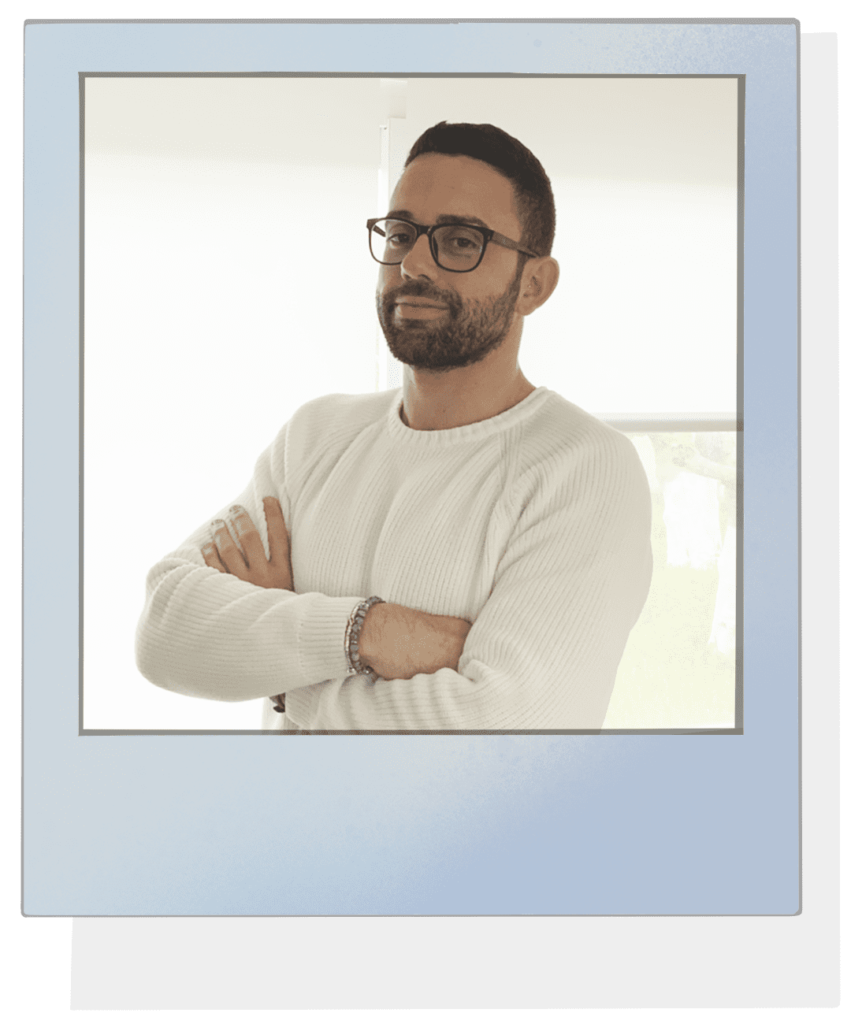
Today, we’re introducing you to Gabriele Cometa, a professional in the field, a member of Team Larry and who, despite happening to be in an all-female group, defends himself great.
We imagine that Larry is conducting the interview.
Below you will find lots of practical tips to get you started in this world step by step. You can also just learn more about what the web designer does and find out how it can be useful for your business.
To date, the professional skills around Marketing and Communications are still unclear to the general public, which is why we are here to highlight the added value of each team member.
We have done this previously with the interview with Cindy Pedone , our illustrator, today we do it with Gabriel, and to follow up we will do it with Larry’s entire team.
Our motto? Demonstrate value and competence by always putting enthusiasm and passion into it!
Let’s leave it to Larry
Larry: “Hi Gabriel, let’s start with an “easy peasy” question. How did your desire to shout “I want to be a web designer” to the world come about?
Gabriel: “About my‘vocation‘ there would be much to tell.
I started doing this work partly for fun and partly out of necessity. I have always loved the world of graphic design! This led me to use, often out of sheer curiosity, programs such as Illustrator and Photoshop.
I have also been a freelancer in the past and have been involved in social media marketing and advertising campaigns.
Soon, however, I realized that the small and medium-sized businesses I was dealing with, before social and sponsored, needed a new website.
Thus, I specialized in creating websites without the use of source code (or programming language).
I have been able to experiment with my work without the use of code through CMSs, such as the famous WordPress, which, accompanied by the use of a visual page builder-such as Elementor (a WordPress plugin)-can yield amazing results!
How? Starting from a blank page, just as a programmer would, but taking advantage of drag and drop (click and drag) technology to insert sections, columns, and forms into the page that allow you an absolute level of customization. Need to add text, an image or a contact form (just to name a few)? With a page builder you can and do visualize the result in real time.
I would like to make one thing clear: these tools, without advanced graphic taste, would not have the same output! They have often told me they can do it, and of course I always leave the final judgment to them.”
Trends and implementations
Larry: “How do you stay abreast of the latest trends or implementations?”
Gabriel: “This aspect is often underestimated.
Today, the best way to stay abreast of new trends is to always keep in touch with those who do the same work as me: on a practical note, every day I am researching and observing the work that my better colleagues are doing. There is always something new to learn!
In this sense, web designers are often influencers. Let me explain further.
A great many of them have highly-followed Behance profiles (a kind of social portfolio that provides a totally customizable bulletin board), on which they post work and projects daily.
Instagram is also a very useful social network for those who want to stay up-to-date, with pages of hundreds of thousands of followers making informative posts every day about new trends in web design, focusing on useful tips and advice (just search for “web design” on Instagram and the best accounts in the industry will appear).
Moreover, they themselves re-post content from a variety of web agencies around the world-I would say there is no better way to be inspired every day!”
Myths to dispel
Larry: “Is there any myth to dispel relative to the world of web designers”?
Gabriele: “The web designer is still a profile that is not too well known: usually my profession is simplified to the nth degree by thinking that it is simply someone who “makes websites.” This is because you have a really sketchy idea of what the web designer is capable of doing.
The web designer cannot be considered a mere performer; in fact, he or she is anything but: he or she should be the mind behind a web project.
In fact, the web designer should not also be a web developer. In an ideal world, the two figures should work four-handedly on creating a website:
- The web designer should take care of the initial analysis phase, the relationship with the client to understand the client’s needs and goals. In addition, it should make a mockup of the site following basic UX principles.
- The web developer should implement what the web designer did by creating the site in code.
To date, however, with the advent of CMSs, it is no longer necessary to create Web sites from code (except for projects in which the client requires complex and structured functions. In these cases, there is no alternative to using code!).
The figure of the web designer then, also deals with the creation of the site, using CMS software.”
The evolution
Larry: “What changes have you seen in your profession over time? How has the figure of the web designer evolved?”
Gabriele: “The figure of the “new” web designer must first and foremost be an expert in User Experience (UX), that is, he or she must find ways to make the content of a site beautiful and interesting but above all useful to those who browse it.
The primary goal of UX is just that: to keep user engagement and interest high at all times.
You need to make the user feel pampered by walking them through a navigation path that leads them to perform a final action (such as: contacting the company, signing up for the newsletter, making a purchase).
Otherwise, the user will leave the site forever.
In addition, today’s web designer absolutely must have a good foundation in graphic design and know the principles of SEO focusing on the choice of page titles, positioning of H1, H2, H3, H4, etc.
Having these skills is not taken for granted, in fact most of the time they are considered pluses that make my role more complete and, in a sense, more complex.”
The value added
Larry: “What do you think makes you unique? What is your added value?”
Gabriele: “Definitely choosing not to use preset templates or the classic “themes” offered by the major CMSs out there means having a great mastery of the tools.
This allows me to be completely “free” leaving room for my creativity, always preceded by a thorough analysis of the client’s specific needs. So, I absolutely say yes to creativity andaesthetics but that they are always supported by a strategy, visual and copy that will convert.”
The Neurobranding
Larry: “How can it, neurobranding, affect the web designer’s choices”?
Gabriel: “Here a world opens up for many people that is still unexplored.
Neurobranding and its principles are of fundamental help in structuring a website with the primary purpose of generating conversions, that is, getting the user to take an action.
I try to go further by listing the 6 basic principles of neurobranding and also explaining how to apply them.
- Reciprocity: give something of value to the reader and he will be more likely to give something in return to you. Ex. Lead magnet: give an e-book as a gift to your customer by receiving his or her contact information in return, which you can leverage later to build a relationship and a community of loyalists.
- Consistency: be as consistent as possible in your online strategy. Ad hoc promotions, coordinated image, communication of your work principles and business values are the key tools!
- Social proof: new users who land on your website will be more likely to request information or make purchases from your online shop if you show them how happy your customers are (for example, highlight the positive reviews you receive).
- Sympathy: tell something about yourself in the pages of your site, reveal some anecdotes, make yourself human. This will bind your reader and you will be “closer” to them.
- Authoritativeness: Build an authoritative image of yourself or your brand, communicate how you work and what titles or accolades you have received. By nature, humans tend to trust and buy from those they consider “experts” in a specific field.
- Scarcity: Create timed offers on your website or implement the sale of an exclusive or limited edition product-your conversions will increase!”
The Larry Method
Larry: “I know for a fact that you have a surprise in store for us, don’t you?”
Gabriel: Dear Larry, you really don’t miss a thing! My surprise is telling about the Larry Method that I “use” every time I start building a site from a blank page.
- Client and stakeholder briefing: at this stage I gather as much information as possible: needs, dreams, past experiences, future goals.
- Market analysis: at this stage I throw myself headlong into the study of the competition, outlining at the drop of a hat the model customer we need to “target” (what are the buyer personas?). In addition, I choose the most appropriate tools to use for optimal performance (I choose which CMS and visual page builder to use).
- Site creation: this is the most fun phase for me. The one where I go to work basically. I jump in without a parachute to dare just enough to create work in line with my expectations and those of the team.
- Final presentation: well, this is the complimentary stage. We usually make eye contact, smile, and are already ready for the next customer.”
Larry: “Thank you, Gabriel, for these really interesting pearls-they are a treasure we will treasure.”
Gabriele: “Larry thank you so much for giving me the opportunity to express my personality through the work I do every day, always with an extra bit of precision and passion! I would like to take this opportunity to invite everyone to visit the Larry Agency’s website which I have curated from start to finish!”
Larry: Wow! Now you are the one throwing assists at me! I would say that anyone who has curiosity about the world of web designers or wants to explore some aspects specifically, can contact us directly here!